What Is the Internet of Things (IoT)? How Smart Devices Work, What They Collect, and How to Keep Them Safe in 2026
- Primary Signal: What Is the Internet of Things (IoT)? How Smart Devices Work, What They Collect, and How to Keep Them Safe in 2026
- Overview: Your thermostat knows when you leave the house, your watch counts every heartbeat, and your doorbell films everyone who walks up your path — and none of them asked you first. That ...
- Verification: Analyzed and compiled by CyberTech 568 editorial monitoring desk.
Your thermostat noticed the house was empty and turned the heating down. Your watch counted your heartbeat while you slept and flagged an irregular rhythm. Your doorbell filmed a delivery driver, recognised the box, and told your phone before you heard the knock. None of these devices asked you to type anything. They sensed something, shared it, and acted on it — and that, in one sentence, is the Internet of Things. It is the name for the network of physical objects fitted with sensors, software, and an internet connection so they can collect data and exchange it with each other, often with little or no human involvement. The objects are ordinary: light bulbs, locks, fridges, tractors, hospital monitors, streetlights, factory machines. What is new is that they can observe the world, talk to each other about what they observe, and respond. At the end of 2025 there were about 21.1 billion connected IoT devices in the world, according to market-research firm IoT Analytics — not counting phones, laptops, and tablets — up 14 percent from 18.5 billion a year earlier, and the same firm forecasts roughly 39 billion by 2030. This guide explains what the Internet of Things actually is, how it works step by step, what your devices collect and who gets that data, why these gadgets are hacked so often, and exactly how to keep a smart home safe.
Here is the Internet of Things in one sentence: it is the network of physical objects — anything from a light bulb to a combine harvester — that are fitted with sensors and an internet connection so they can collect data, exchange it with other devices, and act on what they learn, usually without a person doing anything. The term was coined in 1999 by computer scientist Kevin Ashton, who was trying to solve a simple problem at Procter & Gamble: computers knew a lot about the digital world but almost nothing about the physical one, because every piece of information had to be typed in by a human. His idea was to give objects the ability to report on themselves. The idea itself is older than the name. In the early 1980s, students at Carnegie Mellon University wired a campus Coca-Cola machine to the network so they could check from their desks whether it was stocked and cold before walking over — the first connected appliance, built decades before anyone called it IoT. What changed since then is not the idea but the price: sensors, processors, and radios that cost hundreds of dollars in 1999 now cost a few dollars, so connectivity could move from one vending machine into almost everything.
Start by clearing up the most common confusion: the Internet of Things is not the internet, and it is not your phone. Your phone is a general-purpose computer that you operate. An IoT device is usually a single-purpose object that operates itself: a thermostat's job is temperature, a soil sensor's job is moisture, a heart monitor's job is rhythm. It is also not the same thing as a smart home. A smart home is one application of IoT — the one most people meet first — but IoT also runs through factories, hospitals, farms, power grids, warehouses, vehicles, and cities, most of which you will never see. Nor is IoT the same as artificial intelligence, though the two are increasingly paired: IoT supplies the senses, AI supplies the judgement. A sensor can tell you a machine is vibrating oddly; an AI model can tell you the bearing will fail in three days. Finally, IoT is not one technology. There is no single IoT network, no single IoT standard, and no single company in charge. It is a loose collection of devices, radios, protocols, cloud services, and apps that happen to share the same pattern: sense something, send the data somewhere, decide what it means, and act on it.
Every IoT system, from a ten-dollar smart plug to a connected oil rig, runs the same four-step loop. Step one is sense. A sensor measures something physical and turns it into data: a temperature sensor reads degrees, a motion sensor reads movement, an accelerometer reads vibration, a GPS chip reads location, an optical sensor reads a heartbeat from the light reflected off your skin. Step two is communicate. The device sends that data somewhere — to your phone, to a hub in your home, or to a cloud server — over Wi-Fi, Bluetooth, a mobile network, or a low-power radio. Many devices do not talk to the internet directly at all; they talk to a gateway, a small box that collects data from dozens of nearby devices and forwards it in one stream. Step three is decide. Software looks at the data and decides what it means: the room is empty, the soil is dry, the heart rate is abnormal, the machine is vibrating in a pattern that usually precedes a failure. That decision can happen in the cloud, on a nearby gateway, or increasingly on the device itself — a shift called edge computing, where the processing moves closer to where the data is produced. Step four is act. The system does something: it sends you an alert, it switches on a valve, it adjusts the heating, it locks a door, or it stores the observation for later. The loop then repeats, sometimes hundreds of times a second. A useful way to remember it is sense, communicate, decide, act — and the whole point of IoT is that the loop runs without a person in the middle.
An effective IoT system relies on four pillars, and a weakness in any one of them limits the whole system. The device is the hardware that touches the physical world: sensors that detect changes like temperature, motion, pressure, light, or humidity, and actuators that do something about them, like turning a switch on or off, opening a valve, or sounding an alarm. A device also needs a small processor and an identity — usually an IP address or a unique identifier — so the network knows which device is talking. The data is what the devices produce, and it is enormous: a single factory can generate terabytes a day. Collecting it is only the start; it has to be stored somewhere, usually in the cloud, and organised so it can be searched and analysed. The analytics is where raw readings become useful information: filtering out noise, spotting trends, and turning a stream of numbers into an insight, like noticing that a pump's vibration has been drifting upward for a week. The connectivity is the network that ties it all together — consistent, high-bandwidth links between devices and the cloud, and low-power links for devices that run on batteries for years. If any pillar fails, the system fails: a perfect sensor with no connection is useless, and a perfect connection carrying bad sensor data is worse than useless, because it produces confident wrong answers.
There is no single IoT network because different devices need different things. Wi-Fi is the one most people know: fast, everywhere in homes and offices, and power-hungry, which is why it suits mains-powered devices like cameras and speakers but not a battery sensor that must last five years. Bluetooth is short-range and low-power, ideal for wearables talking to the phone in your pocket. For devices that need to run for years on a coin battery, there are low-power radios like Zigbee and Z-Wave, which form mesh networks where each device relays messages for its neighbours, so the network gets stronger as you add devices. For things spread across fields and cities, there are long-range, low-power networks like LoRaWAN and NB-IoT, which can reach a sensor kilometres away while sipping battery. Mobile networks — 4G, and increasingly 5G — cover vehicles and anything that moves. The real story of 2026 is not a new radio but a new agreement: Matter and Thread. For years, smart-home devices from different brands refused to talk to each other, so a house full of gadgets needed a shelf of apps. Matter is a shared standard backed by Apple, Google, Amazon, and Samsung that lets certified devices work together regardless of brand, and Thread is the low-power mesh radio that carries Matter messages between devices. In 2026, Matter and Thread are steadily reducing the fragmentation that made smart homes frustrating, which is why a device bought today is more likely to keep working with the rest of your home than one bought three years ago.
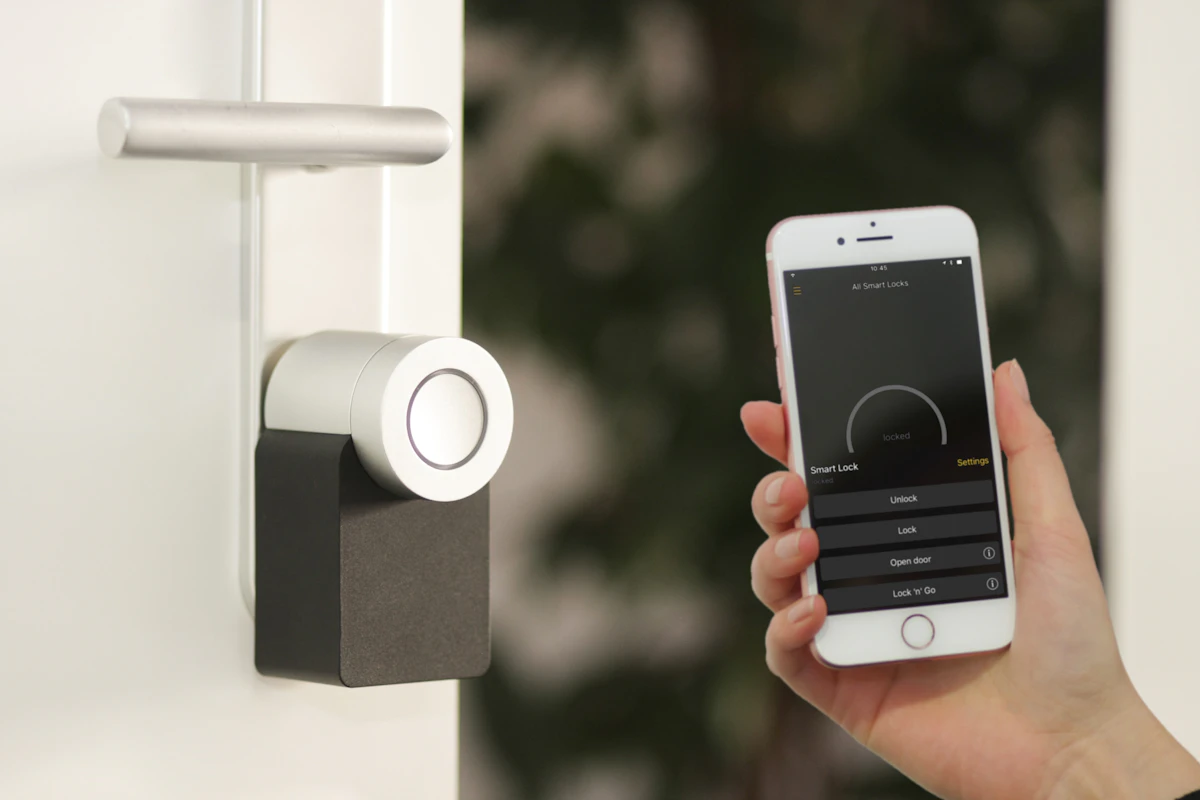
The smart home is the easiest version of IoT to recognise, and it is a good place to see the sense-decide-act loop in action. A smart thermostat reads the temperature and whether anyone is home, learns your routine, and heats the house before you wake up instead of all night. A smart lock knows who arrived and when, and can give a cleaner a code that works only on Tuesdays. A video doorbell watches the porch, distinguishes a person from a passing cat, and shows you the visitor on your phone wherever you are. A smart speaker is the voice interface for the whole system, and a smart plug turns any ordinary appliance into a switchable one. Wearables are IoT you carry on your body: a smartwatch reads your heart rate, blood oxygen, sleep stages, and step count, and can call for help if it detects a hard fall and you do not respond. None of these devices is impressive on its own. The value appears when they combine: the door locks itself when the last phone leaves the house, the lights switch off, the thermostat drops, and the cameras arm — a routine that would take a person a minute, done automatically every time. The catch is that every one of these devices is also a sensor in your most private space, recording when you are home, when you sleep, and who visits, which is why the data question matters as much as the convenience.
The smart home is only the front door. Most IoT devices live where consumers never see them, and that is where the economic impact is largest. In factories, vibration and temperature sensors on machines feed predictive maintenance systems that warn engineers a bearing will fail days before it does, so a machine can be repaired during a planned stop instead of halting a production line. In farming, soil-moisture sensors tell irrigation systems exactly which field needs water and how much, cutting water use while raising yields, and livestock tags track an animal's health and location across thousands of acres. In hospitals, connected monitors track patients' vital signs continuously and alert nurses the moment something changes, and smart pill dispensers record whether a dose was actually taken. In cities, connected streetlights dim when no one is around and brighten when a pedestrian approaches, waste bins report when they are full so trucks only visit when needed, and traffic sensors adjust signal timings to the actual flow of cars. In logistics, a shipping container reports its temperature, humidity, and location in real time, so a shipment of vaccines that gets too warm is flagged before it reaches a pharmacy. The pattern is the same everywhere: replace a guess or a scheduled check with continuous measurement, and the waste, the failures, and the surprises shrink.
This is the part of IoT that most buyers never think about until later. An IoT device is a data-collection point, and the data it collects is often far more detailed than people assume. A smart speaker listens for its wake word, which means its microphone is always on, even when it is not recording. A video doorbell records everyone who approaches your door, including neighbours and passers-by who never agreed to be filmed. A smart TV can record what you watch and when. A fitness tracker knows where you run, how you sleep, and what your resting heart rate is — health information that is valuable to insurers and advertisers. Where does the data go? Usually to the manufacturer's cloud servers, where it is used to run the service, improve the product, and often to train models and target advertising. The privacy policy — the document almost nobody reads — is where the manufacturer says what it collects, how long it keeps it, and who it shares it with. Some companies keep data on the device and process it locally; others send everything to the cloud and keep it indefinitely. The honest rule is that a connected device is a trade: you get convenience and automation, and in return the manufacturer gets a continuous stream of information about your home, your habits, and your body. That trade can be worth it, but it should be a conscious choice, not an accident, and the first thing to check before buying any smart device is what it collects and whether you can turn the collection off.
IoT devices are hacked far more often than laptops or phones, and the reasons are structural, not accidental. First, many devices ship with weak security by design: default passwords like admin/admin that users never change, unencrypted connections, and no way to update the software at all. Second, manufacturers of cheap gadgets often have no business model for security: once the device is sold, there is no revenue to pay for patches, so vulnerabilities discovered a year later are never fixed. Third, there are simply so many devices, and they are always on and always connected, which makes them easy targets for automated scanning — a bot can probe millions of internet-connected cameras in an afternoon. The consequences are real. Infected IoT devices have been assembled into botnets that launched some of the largest denial-of-service attacks in internet history, knocking major websites offline. Hacked cameras have been used to spy on homes. A compromised smart lock is a physical security problem, not just a digital one. And because IoT devices sit inside your home network, a hacked light bulb can be a stepping stone to the laptop on the same Wi-Fi. The industry knows this, and standards are improving — many countries now ban default passwords and require security updates for a minimum period — but the market is still full of cheap devices that were built to a price, not to a security standard. The device that costs half as much usually costs that much less because someone skipped the security work.
You do not need to be a security expert to run a safe smart home — you need a routine, and it takes about an hour to set up. One, change every default password the day you install a device, and use a unique password for each one; a password manager makes this painless. Two, turn on two-factor authentication on the manufacturer's app and account, so a stolen password alone is not enough. Three, keep firmware updated: check for updates monthly, and turn on automatic updates where the option exists. Four, put IoT devices on a separate Wi-Fi network from your computers and phones — most modern routers offer a guest or IoT network — so a hacked bulb cannot reach your laptop. Five, turn off features you do not use: if you never use remote access, disable it; if a camera has a microphone you do not need, mute it. Six, buy from manufacturers with a real track record of security updates, and check how long they promise to support the device before you buy it. Seven, disable Universal Plug and Play (UPnP) on your router, because it lets devices open ports to the internet without asking you. Eight, review what each device collects in its privacy settings and switch off data sharing and voice recordings you do not need. Nine, unplug or replace devices the manufacturer has stopped supporting — an unpatched device is an open door. Ten, check the device's app occasionally for unknown logins or unfamiliar activity, the same way you would check a bank statement. None of these steps is difficult. The risk comes from doing none of them, which is what most households do.
It is worth asking what is genuinely new here, because the honest answer is narrower than the marketing. The internet connected computers; IoT connects the physical world to computers. Three things changed at once. First, scale: there are now more connected things than connected people, and the gap is widening — roughly 21 billion IoT devices against about 5.6 billion internet users. Second, autonomy: traditional internet devices wait for a person to act, while IoT devices act on their own, which means they make decisions that used to require a human — and sometimes they make them wrong, like a smart lock that misreads a signal or a thermostat that heats an empty house. Third, consequence: a hacked email account is a digital problem, but a hacked connected car, insulin pump, or industrial valve is a physical one. The stakes of a software bug rise when the software controls the real world. None of this means IoT is a bad idea. It means the engineering standards that were acceptable for a website — ship it, patch it later, apologise if it breaks — are not acceptable for a device that controls a door lock or a factory. The technology works, and it is already woven into daily life. The question for the next few years is not whether IoT grows — it will, to roughly 39 billion devices by 2030 — but whether the security and privacy practices around it grow up at the same speed.
The Internet of Things is the network of physical objects fitted with sensors and an internet connection so they can sense the world, share what they sense, and act on it without a person in the middle. The idea is older than the name — Kevin Ashton coined the term in 1999, and Carnegie Mellon students connected a Coke machine in the early 1980s — but the price of sensors and radios has fallen so far that connectivity has moved into almost everything: about 21.1 billion devices at the end of 2025, heading for roughly 39 billion by 2030. Every system runs the same loop — sense, communicate, decide, act — carried by networks from Wi-Fi to Matter and Thread, and the value shows up everywhere from a thermostat that heats an empty house less to a factory sensor that predicts a breakdown before it happens. The trade is real, though: every connected device is a sensor in your home or on your body, collecting data that goes to a manufacturer's cloud, and many cheap devices are built with security as an afterthought. That does not mean avoiding smart devices — it means choosing them deliberately, checking what they collect, changing the defaults, updating them, and putting them on a separate network. IoT is not magic and it is not a fad. It is the internet growing senses and hands, and like any powerful tool, it rewards the people who understand what it is actually doing.
More from CyberTech 568